
Imagine this scene: The alarm goes off, and before you even open your eyes, a list of to - dos starts racing through your mind.🏃Stress has now become the “invisible roommate” of our lives, affecting our productivity, relationships, and health. At myTherapist, we see people struggling with these feelings every day, and we know that managing stress isn’t a matter of “willpower,” but of the right strategy and specialized support.
What is anxiety in “plain English”? 🧠
Many of us confuse anxiety with fear. The key difference you need to know is this:
- Fear: It is the reaction to a real, present danger (e.g., a car coming toward us).
- Anxiety: It is our body’s reaction to a potential threat that hasn’t happened yet. It is the worry about “what if…”.
Essentially, anxiety is our body’s primitive alarm system that activates to protect us. It is a biological response that prepares the body to face a threat. In ancient times, this system helped us survive wild animals by giving us the energy needed to (Fight or Flight).
However, our brain cannot always distinguish between physical danger and psychological pressure. Today, the “enemy” has taken on a new form and often manifests as:
- 📝 Tight deadlines: The feeling that there is never enough time at work.
- 💳Financial insecurity: Anxiety about monthly bills and obligations.
- 🗣️Difficult relationships: A heated argument with our partner or a misunderstanding with those around us.
- 📱Digital noise: Constant exposure to negative news and comparisons on social media.
- ⏳Lack of balance: The exhausting effort to simultaneously fulfill the roles of employee, parent, friend, and ourselves.
- 🔮Overthinking: The tendency to “play out” disaster scenarios for the future in our minds.
When this alarm stays on for a long time - what we call chronic stress - our body and mind become exhausted. The adrenal glands constantly secrete cortisol (the stress hormone), which, when maintained at high levels, causes chronic fatigue, insomnia, irritability, and difficulty concentrating.
Stress in Numbers 📊
Anxiety is not a sign of “personal weakness,” but a global reality clearly reflected in the statistics:
- 🌍 1 in 4 people worldwide will experience an anxiety disorder at some point in their lives.
- 📈 75% of visits to general practitioners σχετίζεται άμεσα ή έμμεσα με συμπτώματα άγχους.
- 🩺 Anxiety and physical symptoms: Anxiety often manifests physically, causing severe headaches, stomach problems, skin issues, and muscle pain.
If you feel that stress has started to overshadow your happy moments, myTherapist is here to give you the tools to regain control.
5 simple says to manage Anxiety in your daily life
You don’t always need drastic changes to feel better. Here are 5 practices you can start today:
1. 🌬️Diaphragmatic Breathing Technique (4-7-8)
When we’re anxious, our breathing becomes shallow and rapid, sending a signal to the brain that “we’re in danger.”
- Inhale through your nose for 4 seconds (feeling your belly expand, not your chest).
- Hold your breath for 7 seconds.
- Exhale slowly through your mouth for 8 seconds.
- This activates the parasympathetic nervous system, which acts as our body’s “natural anxiolytic” against stress.
2. ☕Micro-breaks: The Power of 5 Minutes
Our brain operates in cycles of about 90 minutes. Working continuously without a break leads to mental fog (brain fog).
- Every 90 minutes: Take a 5-minute break away from screens.
- What to do: Look out the window, drink a glass of water, or take a few steps.
- What to avoid: Don’t check Instagram or your emails. The “reset” needs to be complete.
3. 📝 Brain Dump: Writing Down Thoughts
The thoughts swirling in our minds are like dozens of open windows on a frozen computer.
- The process: Grab a piece of paper and write everything down. No filtering, no need for proper grammar.
- Why it works: Getting your thoughts out of your head and onto paper makes them more objective and less intimidating.
- Tip: Do this 15 minutes before bed to “clear” your mind.
4. 🏃 Mindful Movement
Stress doesn’t just happen in your head - it gets stored in your muscles, neck, and back.
- Take a brisk walk or do some basic stretching for 15 minutes during the day.
- The benefit of this is that exercise "burns off" excess adrenaline and releases endorphins, the body's natural stress relievers.
5. ⏱ The 5-Minute Rule
Procrastination fuels anxiety. The more we avoid something, the more our fear of it grows.
- The Commitment: Tell yourself, “I’ll work on this for just 5 minutes, and then I can stop.”
- The result: As soon as you start working on what you’ve been putting off, the psychological pressure decreases and your momentum increases. In the first five minutes, the “mountain” you had in your mind starts to look like simple steps, and most of the time you’ll find it’s easier to keep going than to stop.

Why Does Self-Help Meet Therapy?
The practices above are important tools for “first aid” for anxiety. However, to radically change your relationship with anxiety, psychotherapy is the next essential step. So why do these practices work better with a specialist?
- 🔍 Identifying Triggers: While breathing calms you down, the therapist helps you understand why your alarm system is so sensitive.
- 🛠️ Personalized Toolkit: Not all techniques work for everyone. Your psychologist will suggest tools (such as CBT or Mindfulness) that fit your needs and your personality.
- 🛡️ Safe Environment: You have a non-judgmental space where you can express even your most “irrational” thoughts.
- 📈 Lasting Change: Therapy doesn’t just offer relief, it changes the way you process challenges in the long term.
Through the sessions, you can understand why you feel anxious, when anxiety is most triggered, and how to manage it more effectively.
The myTherapist Experience
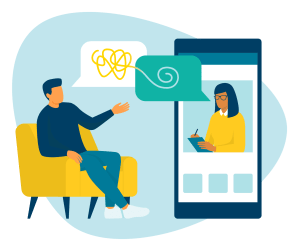
The myTherapist platform was created to break down the barriers that keep people from getting the support they need. We know all too well that when someone is suffering from anxiety, the process of finding a therapist, traveling to appointments, and waiting can be exhausting in and of themselves.🚗❌
That’s why we focus on building a relationship based on trust and safety. The therapist will work with you to build a toolkit for managing anxiety tailored exclusively to your life, helping you take back control of your daily life.
Don’t wait until your anxiety becomes a “storm” to seek support. Listen to your body and give it the care it deserves today.
Bibliography
- American Psychological Association (APA), “Stress in America: A National Health Crisis” (2023).
- Harvard Medical School, “Understanding the Stress Response” (2020).
- World Health Organization (WHO), “Mental health: strengthening our response” (2022).
- National Institute of Mental Health (NIMH), “Any Anxiety Disorder” (2023).
Related articles